Lessons From Peloton's Excess Inventory Crisis
Within 18 months, Peloton went from soaring on pandemic-driven demand to stumbling as gyms reopened and customers began to disappear. Peloton’s excess inventory crisis is a stark reminder of what happens when supply chains fail to prepare for sudden shifts in demand.
However, this story is not just about fitness bikes. It’s about how supply chains can break when forecasting falters, logistics become rigid, and leaders ignore early signals.
Key Nuggets:
- Peloton scaled too aggressively, mistaking temporary pandemic demand for permanent growth.
- Warehouses, and even ships, overflowed with unsold stock as sales collapsed.
- The crisis exposed weak inventory control strategies, poor demand forecasting, and a lack of supply chain flexibility.
- African supply chains can apply these lessons by focusing on flexibility, visibility, and smarter forecasting.
Background Story Behind Peloton’s Excess Inventory Crisis
During the COVID-19 pandemic and the ensuing lockdowns, Peloton bikes became a must-have item. With gyms closed, customers rushed to buy fitness gear that they could use at home.
For Peloton, the behavioral shift meant record demand for its products, and the company attempted to capitalize on it by ramping up production. It bought manufacturers in the U.S. and Taiwan, boosted capacity sixfold, and announced a $400 million factory in Ohio.
But the demand surge was temporary.
Once gyms reopened, demand fell sharply.
However, Peloton’s forecasts did not understand this trend. Instead of planning for multiple demand scenarios, it relied on straight-line growth projections, which analysts later described as a classic example of demand forecasting failures.
Read More: How Brexit Impacted Marks & Spencer’s Food Supply Chain.
The Impact
The impact of Peloton’s excess inventory crisis was severe:
- The Ohio factory project was canceled.
- More than 2,800 employees were laid off.
- Peloton lost $1 billion in one quarter of 2022.
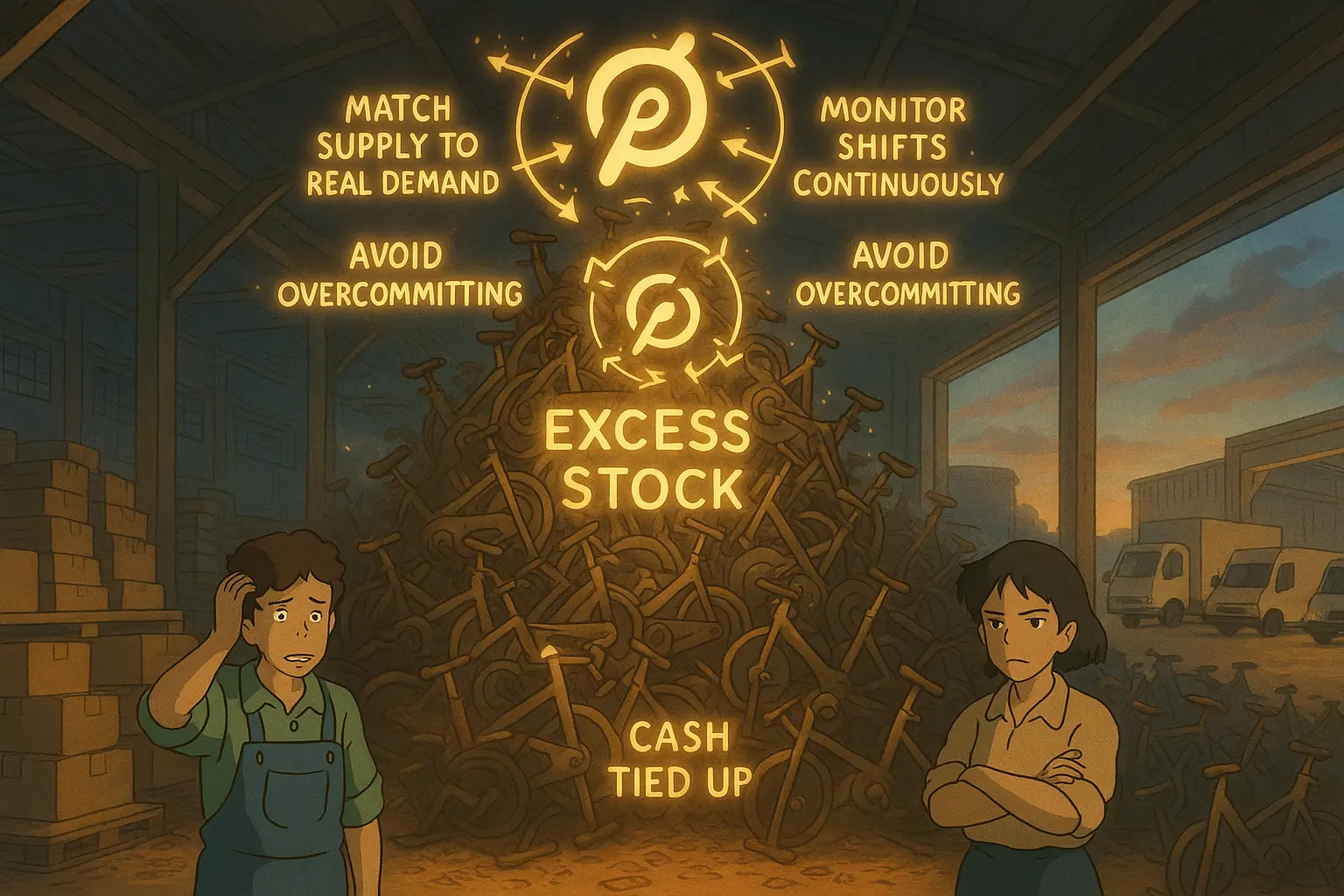
- Excess bikes and treadmills tied up cash and clogged the logistics network.
- Warehouses and delivery centers became stranded assets, draining resources.
What Peloton faced was the bullwhip effect in the supply chain. A small drop in demand led to a massive upstream disruption, exacerbated by overproduction and fixed commitments.
Read More: Lessons From Maggi Noodles Lead Poisoning Crisis in India 2015.
How Peloton Approached Its Excess Inventory Crisis
Peloton thought a shift caused by the pandemic was the new reality. The company was wrong. As sales cooled, Peloton’s warehouses filled up because it had also increased its production. To keep orders moving, the company had to make desperate logistics choices. For example:
- Outsourcing production.
- Drastic discounts for customers.
- Renting ships to store unsold products offshore.
- Paying penalties for containers stuck at congested ports.
- Chartering air freight at more than 10 times the normal cost.
Price cuts had little effect in reducing the mountain of inventory. Some of the staff even described some of the warehouses as packed “like jigsaw puzzles,” with no room left for new stock.
Do you want more supply chain stories like this? Subscribe here.
Lessons From Peloton’s Excess Inventory Crisis
Peloton’s crisis is not unique to the supply chain. There are so many companies across the globe going through the same challenge, but the crisis holds critical lessons for every supply chain leader:
1. Forecasting Must Be Adaptive
Peloton assumed the pandemic surge would last forever. That was a costly mistake. Forecasting must account for uncertainty. Tools like scenario planning, external signals, and predictive analytics can help companies prepare for demand shocks.
2. Guard Against the Bullwhip Effect
Peloton’s experience shows how the bullwhip effect can wreck any supply chain. In this case, orders placed to meet peak demand cascaded into overproduction, which persisted long after sales had slowed.
To prevent a similar scenario, companies must smooth out orders, improve communication with suppliers, and monitor demand shifts in real-time.
3. Balance Control With Flexibility
Owning factories, warehouses, and delivery fleets gave Peloton control during the boom. But when demand fell, those assets quickly became liabilities. By outsourcing the logistics and freight process, the company converted fixed costs into variable ones.
Flexibility proved more valuable than ownership.
4. Invest in Visibility and Analytics
Peloton’s excess inventory crisis happened because the company did not see or failed to understand the warning signs quickly enough. By the time warehouses overflowed, it was too late.
End-to-end visibility and advanced analytics can flag trouble earlier, which is why real-time tracking of inventory and demand signals is now essential for inventory control strategies.
Read More: Why the 2021 McDonald’s Milkshake Shortage in the UK Happened.
How African Supply Chains Can Apply These Lessons
African supply chains often face unpredictable demand, currency shifts, and infrastructure gaps. All of which makes the supply chain more complicated compared to the average supply chain globally.
However, Peloton’s excess inventory crisis and the lessons it offers provide clear guidance.
1. Build Flexibility in Operations
Instead of making heavy investments in fixed assets, African companies can rely on shared logistics hubs and third-party logistics (3PL) partnerships to mitigate risk when demand fluctuates.
2. Strengthen Demand Forecasting
Even small investments in forecasting tools can reduce both stockouts and oversupply. For African firms, this means planning not only for growth but also for sudden drops.
3. Prepare for Volatility
Peloton’s crisis highlights how rapidly markets can shift. In Africa, where imports, exports, and consumer spending can fluctuate significantly, planning for multiple scenarios is essential.
4. Limit the Bullwhip Effect
Closer collaboration between distributors, retailers, and manufacturers can reduce wild swings. Sharing demand data helps stabilize supply chains and avoid costly overstock.
Do you want more supply chain stories like this? Subscribe here.

Obinabo Tochukwu Tabansi is a supply chain digital writer (Content writer & Ghostwriter) helping professionals and business owners across Africa learn from real-world supply chain wins and setbacks and apply proven strategies to their own operations. He also crafts social content for logistics and supply chain companies, turning their solutions and insights into engaging posts that drive visibility and trust.