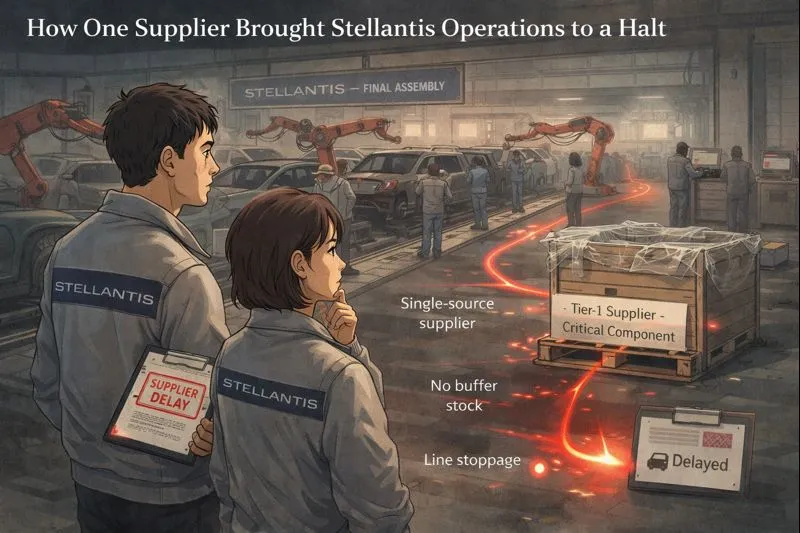
In 2024, one supplier issue halted Stellantis vehicle production across two countries. The company learnt the hard way how easy it was for a small company or supplier to bring a giant company like Europe’s second-largest carmaker to a standstill.
But before we dive into it;
Key Nuggets
- A strike at Stellantis’ stamping supplier, MA France, halted production at three vehicle plants in Europe within days.
- Stellantis had thin buffers and no immediate alternative, which exposed the downside of just-in-time manufacturing.
- The company recovered by rerouting production and relocating tooling from the struck plant.
- The situation showed how tier-2 suppliers, often overlooked, can bring entire supply chains to a halt.
- African supply chains can apply these lessons by improving visibility, redundancy, and contingency planning.
This story is about the vulnerability of relying on a single supplier, the risks of lean buffers, and how speed matters more than size when disruption strikes. It also explores what happened, the impact, and the lessons for supply chains, especially those in Africa.
Background Story Behind Stellantis’ Supply Chain Disruption
It began in April 2024 at a metal-stamping plant in Aulnay-sous-Bois, a suburb of Paris. Though small, the company was deeply embedded in Stellantis’ operations.
MA France produced body and chassis parts for multiple vehicle models, and the integration was highly advanced. Stellantis provided the raw materials, owned the press tools, and received most of the output.
On April 17, workers at MA France went on strike after learning that the company planned to shut down the plant and move production abroad. But it really wasn’t the company’s fault. Stellantis had stopped accepting pricing adjustments and was quietly shifting orders to lower-cost locations.
The strike was organized by France’s major labor unions, including CGT, CFDT, and FO. But it was backed up by local lawmakers. At its heart was a standoff between financial pressure, worker survival, and Stellantis’ push for supplier savings.
Read More: Lessons From ASOS’s Bet on Warehouse Centralization.
Impact of The Supplier Disruption On Stellantis Operations
Within days, Stellantis’ supply chain began to unravel. Without stamped components from MA France, Stellantis couldn’t complete its vehicles. By April 22, three plants had shut down:
- Luton (UK): Production of mid-size commercial vans ceased.
- Poissy (France): Assembly of the DS 3 and Opel Mokka stopped.
- Hordain (France): No vans rolling off the line, including those for Toyota.
Thousands of vehicles were delayed, and workers were placed on partial furlough. Stellantis told the press it was “monitoring” the issue but couldn’t commit to a production restart date. Even Toyota’s supply chain was indirectly affected, too.
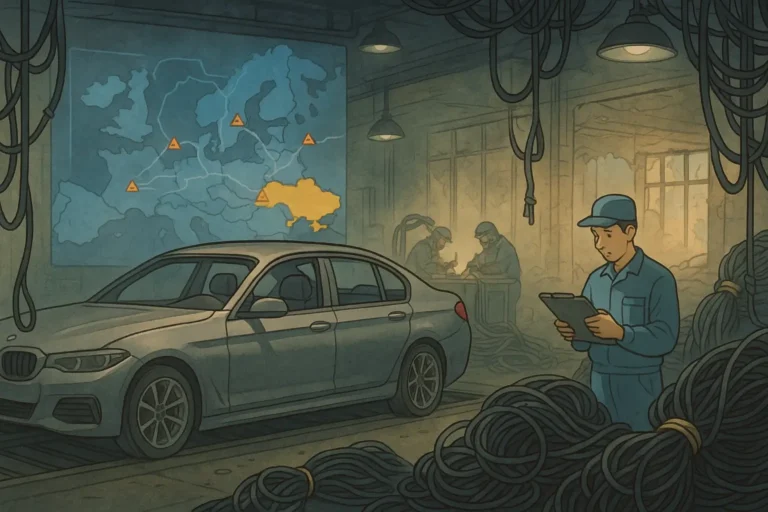
What made the episode more interesting was that MA France was a Tier 2 supplier. But the lack of alternative suppliers or inventory left Stellantis vulnerable. A clear example of what happens when supply chain visibility stops one layer too soon.
Read More: How Sainsbury’s Supply Chain Navigated The UK Driver Shortage in 2021.
How Stellantis Responded to The Supplier Disruption
As the strike continued, Stellantis took two steps at once.
First, it continued negotiations and tracked the situation in MA France. But it made no new pricing offers and warned that the supplier’s issues were structural.
Secondly, behind the scenes, Stellantis activated contingency plans. Trucks were seen leaving the site at dawn. And according to reports, the company had moved tooling out of the Aulnay facility and shipped it, possibly to Turkey or another CLN-owned site.
By April 30, the company announced it had secured alternate production sources. Vehicle production resumed by early May. Poissy resumed on May 2. Hordain and Luton, followed by May 7.
Although the strike was later resolved, details of the terms of the agreement were not made public.
Read More: Lessons From Amazon’s Failed Supply Planning in 2022.
Lessons From the Stellantis–MA France Breakdown
For Stellantis, the disruption lasted about two weeks, but it could have been worse. Here are some of the lessons:
1. Tier-2 Suppliers Can Still Shut Down a Plant
This wasn’t a chip shortage. Neither was it war. It was a domestic strike at a stamping plant. But that plant fed multiple vehicle lines across two countries. Any supplier, no matter how deep in the chain, can be the weakest link.
If your system relies on them and there’s no buffer or backup, then they hold considerable power over your supply chain. Organizations often ignore Tier 2 supplier issues, which is risky. Visibility must go beyond the first tier.
Do you want more supply chain stories like this? Subscribe here
2. Just-in-Time Can Turn Into Just-Stopped
The MA France strike exposed a just-in-time flaw. Because there was no room for delay, once the stamped parts stopped, Stellantis assembly lines stopped.
This isn’t a new concept. But when supply chains are under financial pressure, companies sometimes shrink their buffers too far. It’s fast and cheap, until it breaks.
Critical parts (metal stampings, semiconductors, axles, steering racks) need risk-weighted inventory buffers. That means not every part gets stocked. But the ones that can stall production? They should.
3. Supplier Cost Pressure Can Backfire
MA France was already struggling with inflation, raw material costs, and energy spikes. Stellantis reportedly rejected price adjustment requests, which, in turn, pushed the supplier to the brink.
When that edge was reached, the supplier stopped working. And Stellantis stopped building cars. Yes, aggressive procurement can deliver short-term savings. But it may also trigger hidden costs—line stoppages, missed sales, supplier bankruptcies.
Buyers need to distinguish between strategic cost management and self-inflicted harm.
Do you want more supply chain stories like this? Subscribe here
4. Recovery Depends on Built-In Flexibility
Stellantis didn’t just get lucky. The company had backup tools, internal stamping capacity, and the ability to shift production. That played a key role in its survival. Unfortunately, not many supply chains have that.
Stellantis recovered because it had options. Make sure you always have the same or at least a plan B.
How African Supply Chains Can Apply These Lessons
To apply these lessons, the following approach will be the best way to get started:
1. Map More Than Tier-1
Most supply chain mapping stops at direct vendors. But that is not enough. African manufacturers, retailers, and distributors need to trace key components further down the supply chain.
Answer critical questions such as: Who supplies your packaging, engine parts, or ingredients? Moreover, mapping doesn’t have to be expensive. Simple supplier self-reporting or audits can uncover where your risks lie.
2. Add Buffer Where Failure Hits Hardest
Not every item needs to be stocked. But knowing which parts or inputs would stop everything if they were to vanish, and then adding a buffer, will help prevent excessive damage when a disruption occurs.
For example, a Nigerian food processor can afford to delay label printing. But if palm oil shipments stall, the whole line stops. In this case, the buffer is placed where the risk is highest.
Do you want more supply chain stories like this? Subscribe here
3. Don’t Squeeze Suppliers Until They Snap
If your supplier is struggling and you press for lower rates, something will break. So, rather than doing that, consider shared problem-solving. Maybe prepay to ease their cash flow, help them access a more reliable power source, or co-invest in capacity.
Finding a common ground is cheaper than losing the supplier entirely.
4. Build Your Plan B While Plan A Still Works
Before anything goes wrong, build your fallback. Do the work of finding out if another vendor can produce that part, whether production can be in-house, or whether there are alternate materials.
Finding this information can save you a lot in the future. Even if it costs a little bit now.

Obinabo Tochukwu Tabansi is a supply chain digital writer (Content writer & Ghostwriter) helping professionals and business owners across Africa learn from real-world supply chain wins and setbacks and apply proven strategies to their own operations. He also crafts social content for logistics and supply chain companies, turning their solutions and insights into engaging posts that drive visibility and trust.