How Tiger Brand’s Supply Chain Botched a Listeriosis Outbreak in South Africa
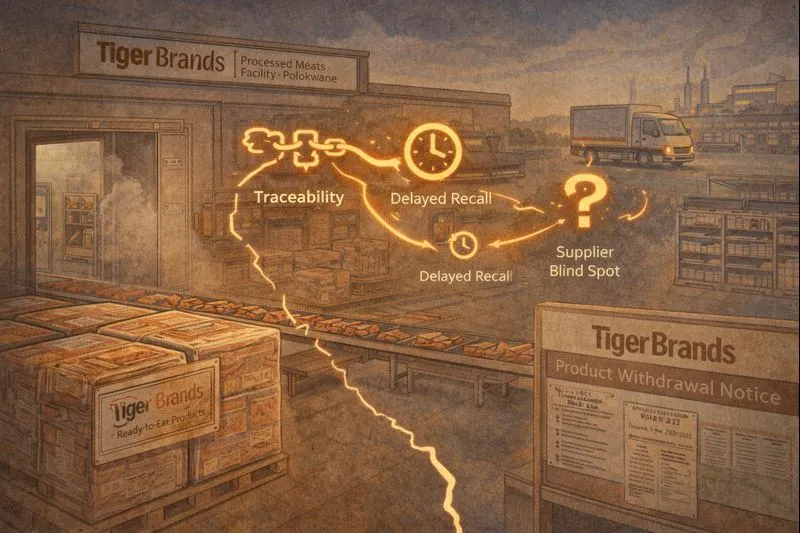
Tiger Brand’s supply chain collapsed in 2018 due to recalls following an 18-month listeriosis outbreak, and the company’s handling of it. A factory‑level food safety failure spread faster than the company could stop product flow.
In this article, we explore why the breakdown happened, how it moved through the supply chain, what damage it caused, and what African supply chains must do differently to avoid a similar fate.
Key Nuggets
- The polony recall, which Tiger Brands announced in March 2018, stopped production, erased shelf supply, and triggered cross-border bans in parts of the region.
- Tiger’s crisis response shows the cost of delay when internal tests raise alarms, but decisions wait on confirmatory work.
- Recall success depends on recall reach, not recall headlines, especially across informal and small retail.
- African operators can apply the same fixes with simple tools: stop-ship triggers, lot discipline, distributor mapping, and recall drills that prove traceability.
Background: How Tiger Brand’s Supply Chain Entered Crisis
Between 2017 and early 2018, more than 1,000 laboratory‑confirmed cases were reported, with over 200 deaths recorded by public health authorities.
In March 2018, investigators traced the dominant outbreak strain, Listeria ST6, to ready‑to‑eat processed meat linked to Enterprise Foods, produced at the Polokwane facility. Enterprise Foods was a subsidiary of Tiger Brands.
Once that link became public, Tiger Brand’s supply chain stopped being a production system and became an emergency system.
Read More: Lessons From Daimler Trucks’ Rare Earth Metal Inventory Strategy.
Why The Crisis Happened Inside The Supply Chain
The crisis began inside the factory. Investigators concluded the outbreak could not have lasted that long without persistent contamination inside the production environment.
According to the World Health Organization, the bacteria had likely “been contaminating all the products coming in and out of that factory for about a year.” It was a resident contamination, in which bacteria survive cleaning routines and continue to seed the finished product.
One food safety expert explained the danger, saying ”the organism can live from the nuts and bolts, to every part of the factory.”
For a food supply chain, this means that every outbound pallet serves as a carrier.
The Second Failure: Delay After the Early Warning Signs
Initially, there were warning signs, but Tiger Brands did nothing. Court‑referenced records showed that the company detected listeria indicators internally before the public announcement.
But instead of halting shipments at the first signal, the company waited for confirmatory work to be completed. That delay mattered because ready‑to‑eat meat recalls in South Africa do not require further cooking by consumers.
When harm is possible, your company should prevent it in any way it can, even if it means shutting down production and the supply chain. Every extra day of delay increases exposure.
However, in this case, the product continued to move.
Read More: Lessons From Flipkart’s Logistics Network Expansion in 2023.
How Tiger Brand’s Supply Chain Responded When The Link Was Confirmed
Tiger Brands’ supply chain took action after the authorities publicly named the source. The company announced the closure of its Polokwane and Germiston Enterprise factories and initiated a nationwide recall of ready‑to‑eat meat products.
This included polony, viennas, and similar items across formal retail.
Operationally, this meant:
- Instant loss of production capacity
- Full reverse flow of finished goods
- Destruction of large volumes of inventory
Tiger Brands later confirmed that at least 3,700 metric tons of product were removed and destroyed.
Do you want more supply chain stories like this? Subscribe here
The Supply Chain Impact Beyond Factories
Once Tiger Brands announced the polony recall, processed meat disappeared from shelves. And consumer trust collapsed across the category, not just one brand. Small food vendors that depended on polony saw demand fall immediately.
Nevertheless, reports showed some gaps in the recall reach. For instance, small outlets continued selling the recalled products because upstream distributors failed to notify them.
This exposed a weak link in the cold chain and recall execution, especially where distribution passes through wholesalers and informal channels. Ultimately, a recall headline does not equal a recall completion.
There was also a regional trade disruption. At least 12 neighboring countries imposed bans or restrictions on imports of South African processed meat. That decision froze export flows and damaged regional supply relationships.
The financial damage was devastating. For instance, Tiger Brands reported hundreds of millions of rand in recall and shutdown costs. And the value‑added meats business reported heavy losses while production remained stopped.
A class action was certified in 2018. But discovery stretched across years.
In later statements, Tiger Brands acknowledged the loss of trust, saying, “Some of that trust has been lost…we need to earn back that trust over time through our actions.”
The company later supported food safety research efforts, stating it wanted to be “at the forefront of initiatives to strengthen the food system.”
Read More: How Ferrari’s Supply Chain Beat the Semiconductor Shortage.
Lessons From Tiger Brand’s Supply Chain Crisis
Tiger Brands’handling of the crisis holds various lessons for supply chains across the continent and beyond:
Lesson One: Speed Beats Certainty
In food supply chains, lives are at atake that is why the correct trigger is risk, not proof.
When a product is eaten without cooking, shipment must stop first, and questions come later.
This applies beyond food to medicine, chemicals, and child products.
Lesson Two: Environmental Monitoring Protects the Whole Chain
Testing finished goods alone is not enough. Resident contamination hides in drains, slicers, conveyors, and seals. Therefore, your monitoring must focus on where bacteria live, not only where the product passes.
A positive trend demands shutdown, deep cleaning, and retesting.
Do you want more supply chain stories like this? Subscribe here
Lesson Three: Recall Success Depends on The Last Mile
During a recall, retailers operating in the formal sector often respond fast, while those operating informally do not. If your supply chain includes wholesalers, sub‑distributors, and small shops, your recall notices must force confirmation.
A recall without acknowledgement leaves the product in circulation.
Lesson Four: Traceability Must Work Under Pressure
Traceability is measured by time. If you cannot locate the affected lots within hours, your recall will expand beyond what is necessary. And that is how one factory issue turns into a national shutdown.

Obinabo Tochukwu Tabansi is a supply chain digital writer (Content writer & Ghostwriter) helping professionals and business owners across Africa learn from real-world supply chain wins and setbacks and apply proven strategies to their own operations. He also crafts social content for logistics and supply chain companies, turning their solutions and insights into engaging posts that drive visibility and trust.