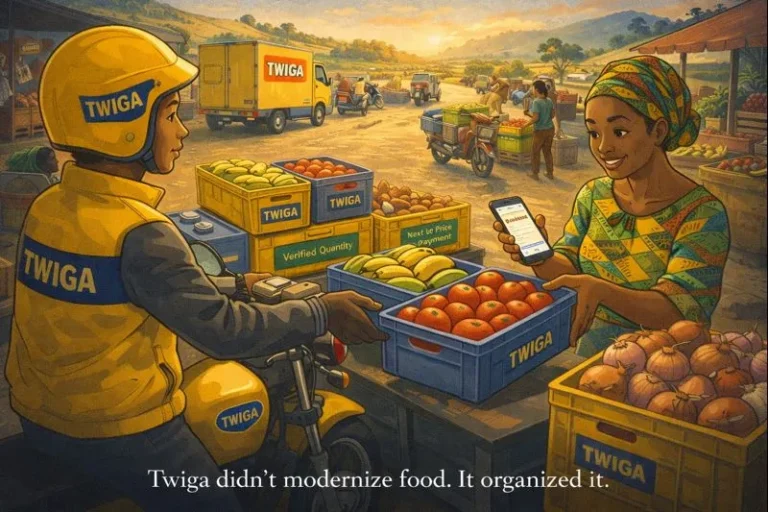
Twiga transformed Kenya’s food supply chain by adopting a distribution and aggregation model that enabled farmers to reach more consumers with less waste and price padding.
The company achieved this by improving the flow and control of food production while leveraging tools already trusted by vendors and farmers, such as smartphones and M-Pesa. But before we dive into the story, here are some key nuggets.
Key Nuggets:
- Twiga Foods linked thousands of small retailers to farmers through a B2B ordering and delivery model.
- Farmers received purchase orders before harvest and payments within 24 hours via M-Pesa. Vendors received free delivery within 24 hours. Twiga ensured consistent quality and lower wholesale prices.
- Post-harvest losses within the Twiga network fell from approximately 30% to approximately 4%.
- Route planning and operational changes reduced delivery costs by approximately 40% in certain periods.
In this story, we examine how Twiga’s distribution model transformed food access in Nairobi by addressing a fragmented system in which more than 180,000 informal vendors served approximately 6 million residents.
The Problem Twiga Foods Distribution Set Out to Fix
Kenya’s produce market had reach, but it lacked coordination. Nairobi relied on a large informal retail base, with over 180,000 small vendors serving daily food needs for millions of residents.
Ideally, that kind of scale should have lowered food prices across the city and the country at large.
However, the flow from farms to stalls was so broken that, for example, food moved through layers of brokers and middlemen, with each layer taking a cut that increased the markup and introduced unnecessary delays, making waste inevitable.
Waste was systematic. For instance, 30–50% of fresh produce in Kenya could be lost due to poor handling, limited cold storage, and long distribution chains.
The consumer impact was evident in household budgets and in food. African households often spend 40–55% of their income on food, and Kenyan households spend nearly 50%.
Small-scale farmers were also impacted. Although these farmers produced much of the country’s fresh food, the system around them, including limited access to buyers, broker power, payment delays, and weak credit, stopped them from making a stable income or even growing their business.
Read More: Lessons From LEGO’s Supply Network Expansion in Asia.
How Twiga’s Food Distribution Worked
Twiga’s food distribution model connected farmers and informal retailers in a B2B context. Instead of selling directly to end consumers, the company supplied vendors that already served the city.
The first move was demand aggregation. Rather than pushing harvest into markets and hoping it would sell, Twiga gathered orders from many small retailers and then purchased produce based on that demand.
The process reduced risk by securing commitments prior to harvest.
Farmers registered by phone, giving Twiga access to their farm produce. The company then issued purchase orders specifying crop type, volume, and harvest dates. Payment was made within 24 hours via M-Pesa. The cash-first approach was key to building trust.
Vendors could place orders via an app, SMS, WhatsApp, or voice calls and receive free delivery to their shop within 24 hours.
The delivery system relied on real assets, including collection centers with cold storage, a central distribution facility in Nairobi, and a distribution fleet covering approximately 12,000 kilometers daily.
Twiga also leveraged technology solutions for routing and demand forecasting, which helped the company reduce delivery costs by 40%.
Read More: Inventory Lessons From The Red Sea Crisis Disruption of Volvo’s Supply Chain.
Why Twiga Foods Distribution Became a Success
Twiga succeeded by reducing adoption friction in the food supply chain. The company realized that vendors did not need to learn a new lifestyle. They just needed food at a fair price and a predictable arrival time.
The payment speed also helped. Farmers who waited days for settlement under the old channels could get paid within 24 hours of Twiga placing their orders. That helped farmers make better planting decisions and build loyalty towards Twiga Foods.
Twiga’s food distribution model also ensured freshness by shortening the time from harvest to shelf. Fewer handoffs meant less bruising, fewer delays, and fewer opportunities for produce to sit in heat and spoil.
The Impact of Twiga’s Distribution Model in Kenya
The biggest measurable change was in post-harvest losses. There was a drop from approximately 30% in losses under the old system to abut 4% for produce moving through Twiga’s network.
That drop was due to a close match between demand and supply. Twiga’s purchases were based on vendor orders, which allowed them to move produce more quickly. They also used cold storage at collection points and distribution facilities.
Consumers could obtain food at lower prices because fewer intermediaries and markups existed between them and farmers.
Vendor economics also improved. They received lower wholesale prices and avoided a full day spent traveling to wholesale markets, which meant more selling time and less cash tied up in waste and turnover.
Financial inclusion for the farmers also improved through digitized records. Every order and payment became a time-stamped trail that later supported credit scoring and lending decisions for farmers with no bank history.
Read More: How Nestlé Nigeria Is Leveraging Local Sourcing to Combat the FX Crisis.
Limits and Turning Points in the Model
Twiga learned that high-impact metrics do not always imply strong economic performance. According to Twiga’s co-founder and CEO, Peter Njonjo, “It’s not a profitable business working with so many small farmers. The cost of aggregation from the long tail is high.”
That “long tail” cost came from real work. Each farmer’s relationship required checks, collection planning, sorting, and quality handling. Doing the same for hundreds of thousands of small-volume farmers spread across wide geographies increased the cost per kilogram.
Twiga responded by shifting to direct farming through Twiga Fresh in 2022. The company leased 650 hectares and focused on crops such as onions, tomatoes, and watermelons to achieve consistency and lower costs.
The “long-tail” approach also raised concerns about food safety. According to Njonjo, if you aggregate from various suppliers, you automatically become accountable. And the company could not ensure that.
Do you want more supply chain stories like this? Subscribe here
How African Supply Chains Can Apply Twiga Principles
African supply chains can draw on Twiga’s thinking without replicating its exact structure. The point is tighter coordination, shorter cash cycles, and shorter lead times for perishable goods, particularly those with short shelf lives.
1. Map the True Bottleneck Before Investing in The Solution
When your supply chain places blame on the wrong factors, the solution will often not work. That is why mapping is very important. It ensures the solution is precise. Twiga focused on handoffs, wasted trips, and slow payment loops because those were the leaks in the system.
Use this quick test in any sector:
- Where does the product wait the longest?
- Where do you lose the most volume to damage or expiry?
- Where does money settle too slowly for suppliers to restock?
2. Build Around The Informal Market That Already Feeds The City
Twiga served informal vendors rather than attempting to replace them. If your market operates through kiosks, roadside vendors, and small shops, treat them as your route to scale. Here are some practical moves that travel across industries:
- Offer multiple ordering paths that align with customers’ existing habits.
- Keep the first user action simple, like placing a repeat order.
3. Use Payment Speed as a Supply Chain Tool
Twiga employed a 24-hour payment plan to enroll farmers in the network. Payment speed determines lead time, and supply chains across Africa should take cues from it. You don’t have to pay every 24 hours, but ensure there is a mutually agreed-upon timeframe and adhere to it.
Do you want more supply chain stories like this? Subscribe here
4. Pressure-Test Unit Economics Before Chasing National Scale
Twiga’s later arc shows why early math matters. Track cost per pickup, cost per delivered unit, loss rates, and cash conversion time before expanding routes, warehouses, and headcount. It will help with supply chain discipline.

Obinabo Tochukwu Tabansi is a supply chain digital writer (Content writer & Ghostwriter) helping professionals and business owners across Africa learn from real-world supply chain wins and setbacks and apply proven strategies to their own operations. He also crafts social content for logistics and supply chain companies, turning their solutions and insights into engaging posts that drive visibility and trust.