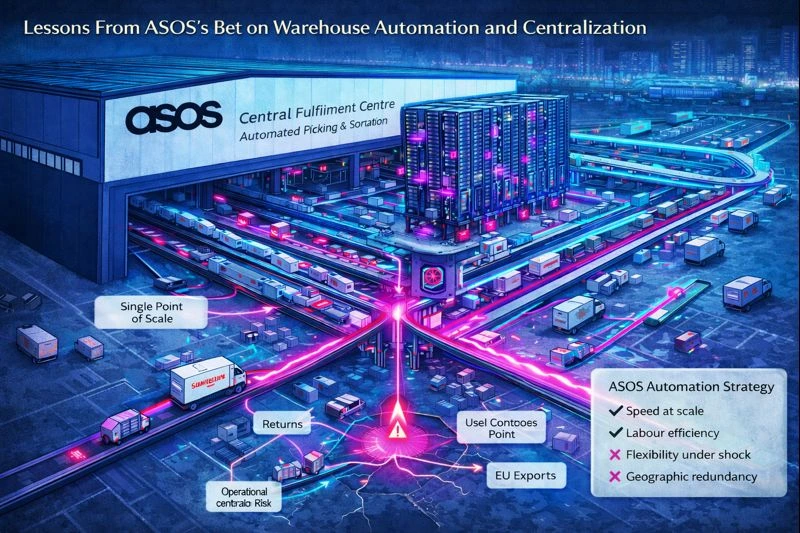
ASOS’s move to centralize its UK warehouse operations overhauled its global supply chain.
However, with automation, the company was able to shrink its logistics footprint and reduce inventory duplication.
Key Nuggets:
- ASOS automated its warehouses to cut costs and simplify operations, but this forced it to rethink how it served international customers.
- It shut down its U.S. distribution center, centralized inventory in the UK, and leaned on smarter returns routing and partner fulfillment models.
- The move offers powerful lessons in network planning, inventory consolidation, automation ROI, and balancing cost with customer speed.
To do that, though, ASOS also had to close its U.S. warehouse, extend delivery lead times, and rewire how customers shop and return items across borders.
In this article, we explain the rationale and lessons behind ASOS warehouse centralization, especially for supply chain leaders operating in constrained markets.
Why ASOS Bet on Warehouse Centralization
By 2024, ASOS was under pressure from two sides.
First, demand had cooled. Customers weren’t spending as much as they used to, especially during the pandemic. Second, rivals like Shein and Temu were flooding the market with low-cost styles and a huge variety. ASOS had to reduce risk and improve margins fast.
But this meant cutting stock.
At the time, the company trimmed inventory by more than 50% over two years, which also raised a bigger question. Why hold duplicate stock across multiple warehouses, especially when most items go out of style in a matter of weeks?
ASOS’s answer was to automate better and consolidate harder.
Read More: How Sainsbury’s Supply Chain Navigated The UK Driver Shortage in 2021.
ASOS Shut Down U.S Warehouse
In 2021, ASOS spent over $100 million automating its U.S. fulfillment center in Atlanta. That facility had the capacity to process over 3 million items per week and was built to speed up U.S. deliveries to 2–3 days.
But by 2025, the model no longer worked.
The volume going through the Atlanta warehouse didn’t justify the overhead.
Holding inventory in both the UK and the U.S. created duplication, markdowns, and a drag on working capital. And ASOS, by the time, had realized that a smarter, more powerful UK hub could serve U.S. orders with fewer nodes.
Shutting down the Atlanta warehouse was a painful but powerful decision. The company took a £190 million impairment on the site and announced a shift to a more centralized model.
Orders to U.S. customers would now ship from ASOS’s automated fulfillment center in Barnsley, UK, and a smaller, flexible local U.S. site would handle key logistics tasks, such as returns routing.
Read More: Lessons From Amazon’s Failed Supply Planning in 2022.
Impact of ASOS Warehouse Centralization
Closing a regional warehouse reshapes more than just operations. It affects the entire customer experience — from delivery time to returns. Here’s what changed one year later.
1. Delivery Lead Times In The U.S.
Customers in the U.S. now wait longer. Standard delivery times range from 5–8 days, up from the 2–3 days Atlanta used to offer. However, express delivery is available for those willing to pay, and ASOS offers a paid “Premier” program to offset delays.
The trade-off is a broader product range and faster availability of new styles. With centralized inventory, U.S. shoppers get the full catalog rather than a filtered one based on local stock levels.
ASOS is betting that customers care more about selection than speed. Early feedback has been mixed but manageable.
2. Returns Routing From The U.S.
Returns didn’t take the same hit.
Rather than asking U.S. customers to ship items back overseas, ASOS partnered with Flexport to manage returns in Texas. Customers still get a local return label. Items are collected, grouped, and sent back to ASOS in bulk. Or repurposed domestically where possible.
This way, the company preserves the easy returns experience customers expect, while reducing reverse shipping costs.
Do you want more supply chain stories like this? Subscribe here
3. Peak Season Capacity Planning
A centralized network means one warehouse now handles more load, especially during peak periods. To cope, ASOS leaned on robotics.
Automating the Barnsley facility allows it to run nearly nonstop. Systems like Nomagic sorters allow more throughput without adding labor. Partner-fulfilled orders also help reduce peak load by allowing brands to ship items directly.
This approach worked through Christmas 2025. But it requires flawless planning and contingency setup to avoid failure during demand spikes.
4. Inventory Strategy and Working Capital
With Atlanta gone, ASOS now pools inventory across fewer sites. This reduces stranded stock and improves sell-through. But it also means less working capital is tied up in duplicate SKUs.
There is a downside, though. If a product runs out in the UK, U.S. customers are out of luck unless ASOS can quickly restock or reroute. So, to make the model work, ASOS invested in better demand forecasting and tighter supplier coordination.
It also leaned into its Partner Fulfils program, which lets selected brands ship directly to buyers — without ASOS holding any inventory.
Read More: How Tiger Brand’s Supply Chain Botched The 2017–2018 Listeriosis Outbreak in South Africa.
Lessons From ASOS Warehouse Centralization and Automation
ASOS’s warehouse move holds key lessons for supply chains. Here are some of them:
1. Automation Needs Network Strategy
ASOS’s Atlanta site was fully automated, but that wasn’t enough. The bigger picture — sales volume, inventory spread, transport cost — made the site unnecessary. Don’t isolate automation from your network model. Always make sure each node still meets the demand.
2. Duplication Hurts More Than Distance
Fashion supply chains with huge SKU variety and fast product turnover suffer when inventory is split across too many warehouses. You end up with the wrong products in the wrong places, and then the markdowns follow.
ASOS managed to cut that by centralizing and consolidating. Lead times rose, but stockouts and waste fell. In high-SKU or seasonal categories, inventory precision beats speed.
Do you want more supply chain stories like this? Subscribe here
3. Beyond Shifting Workload, Automation Also Shifts Risk
Because of automation, ASOS can now handle surges without hiring extra people. But if its UK site goes down, there’s no backup. That is why centralizing fulfillment requires a stronger contingency plan. Run simulations, test peaks, and build flex options. ASOS has one. Do you?

Obinabo Tochukwu Tabansi is a supply chain digital writer (Content writer & Ghostwriter) helping professionals and business owners across Africa learn from real-world supply chain wins and setbacks and apply proven strategies to their own operations. He also crafts social content for logistics and supply chain companies, turning their solutions and insights into engaging posts that drive visibility and trust.