Domino’s autonomous delivery sounded like the future of pizza, but the robot delivery trial with Nuro in Houston showed supply chain leaders something deeper about timing, scale, and cost in last-mile change.
In this article, we will explore what happened with the project and why it was never integrated into real deliveries.
Key Nuggets:
- Domino’s used the Nuro R2 delivery trial to test last-mile robotics during a severe driver shortage, not to replace its driver network overnight.
- The pilot remained small due to speed and weather limits, curbside pickup, and weak unit economics, turning early promise into an autonomous delivery failure.
- The experiment shaped Domino’s supply chain strategy and offers a sober playbook for African supply chains that want new QSR delivery technology without burning cash.
Domino’s Autonomous Delivery Project
The tight job market in 2021 left Domino’s with thousands of open driver roles, resulting in delayed orders, stressed store managers, and a significant impact on Domino’s delivery operations across the United States.
The Domino’s Nuro pilot promised a lifeline.
It was supposed to offer relief and handle deliveries during peak hours when drivers were scarce. The company’s leadership saw the last-mile robotics solution as an experiment to answer three big questions:
- Would customers trust pizza delivery robots?
- Would store teams cope with a new dispatch process?
- And would autonomous vehicle delivery challenges help or hurt speed during busy periods?
According to Dennis Maloney, then Chief Innovation Officer, the company wanted to use the pilot to learn “how customers responded to the deliveries, how they interacted with the robot, and how it affects store operations.” That captured the heart of the experiment.
Read More: Lessons From Coca-Cola Sabco’s Supply Chain Innovations in East Africa.
How the Domino’s Nuro Pilot Worked on Houston Streets
In April 2021, a company-owned store in the Woodland Heights area of Houston began delivering some of its pizza orders with Nuro R2 robots instead of human drivers.
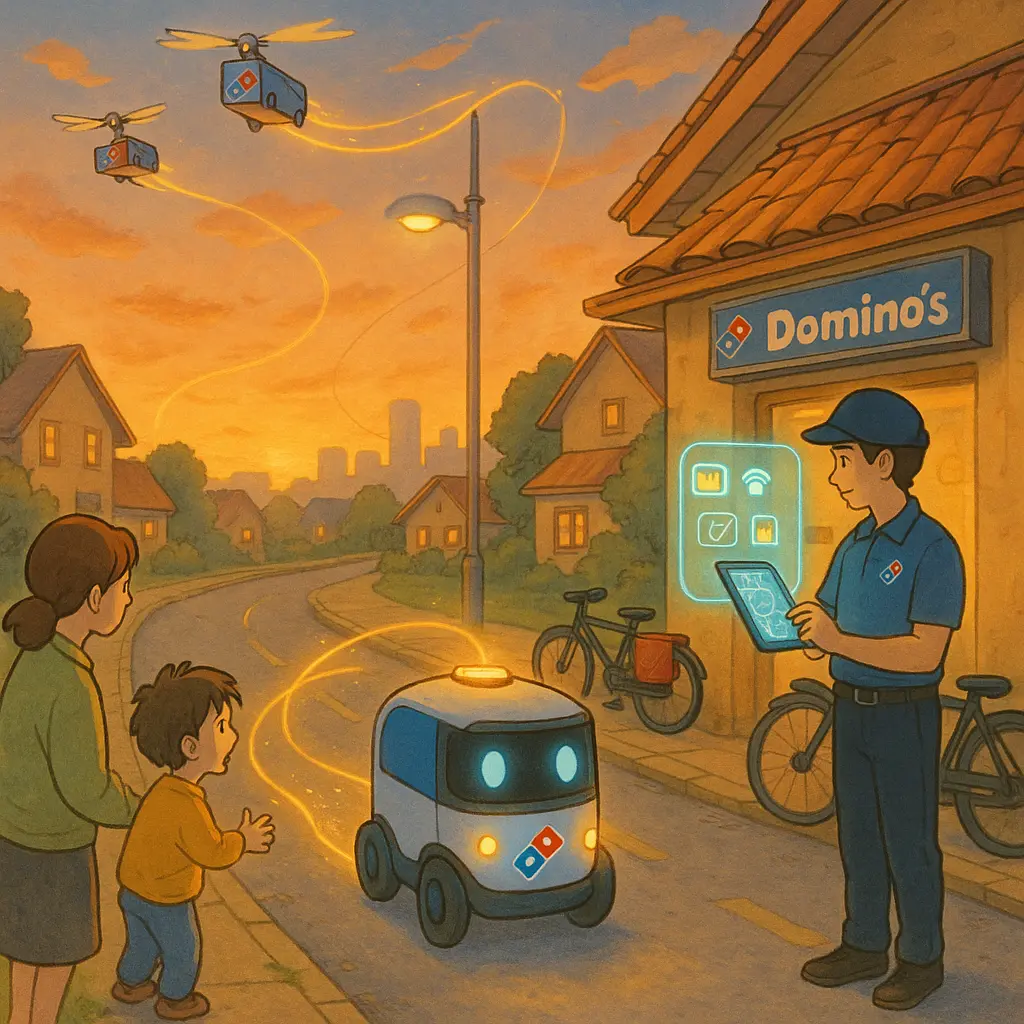
Customers in a small service zone who ordered online and paid in advance could pick a robot-run checkout. Domino’s then loaded pizzas into the small electric pods, which carried only a few orders at a time in heated bays that opened with a PIN at curbside.
The R2 vehicles drove on public streets without people inside, moving at about 25 mph and taking quieter routes instead of the fast main roads that drivers usually take.
But there were teams in place, remotely monitoring each trip, collecting data on how it worked, and analyzing its movement to see whether it was a long-term solution. The Nuro staff were also on standby in case the robots needed help.
When the robots arrived, customers had to walk out to the curb, type in a code on the robot’s touchscreen, and grab their food from the robot’s storage. Many of them liked the novelty, the idea of no driver at the door, and the fact that no tip was expected for a machine.
Read More: How Kraft Heinz’s Supply Chain Ensured Resilience During the Pandemic.
Why Domino’s Autonomous Delivery Was Shelved
On paper, the autonomous delivery project looked like a neat piece of QSR delivery technology: no driver, small electric pod, automated bay doors, live tracking, and curb pickup. But the trial remained a narrow probe rather than a new normal.
1. The Maths Did Not Add Up
The Domino’s autonomous delivery trial ran into basic volume math.
A Nuro R2 pod holds far fewer orders than a car and takes one route at a time. During the evening rush, one or two robots from a single store could never match drivers who stack drops, double back, and solve on the fly.
It was clear that the last-mile robotics could not lift throughput during crunch periods.
2. Delivery Capabilities Did Not Match Pizza Delivery Realities
The technology imposed strict rules that clashed with the realities of pizza delivery.
Speed caps and conservative routing made sense for safety, but created pressure on the pizza oven, the cut table, and the dispatch clock. If the robot had to take slower streets at 25 mph, the store had to start the trip earlier, but still keep the food hot upon arrival.
Any timing glitch left the customer with a lukewarm box and a bad memory.
Do you want more supply chain stories like this? Subscribe here
3. Struggle With The Real World
The robots struggled with the world beyond neat Houston side streets.
Nuro R2 vehicles did well in mild weather and low-complexity areas but were not ready for heavy rain, snow, or tight high-rise zones. That meant the pilot stayed in one sunny pocket and never faced the full mix of addresses that Domino’s sees across thousands of stores.
It was also inconvenient for customers. Human drivers can climb stairs, ring doorbells, and improvise in back alleys. The robots could not do that, and they also froze when roads were flooded or when sensors read clutter.
4. Legal Map Outside Texas Was Messy
Houston and the state gave Nuro room to operate driverless pods, but many U.S. cities either banned this type of vehicle or demanded multiple permits and safety staff.
Each new city would have meant a new round of talks and a fresh risk profile, which slowed the national QSR delivery technology rollout.
5. The Money Problem
The money side never came together.
R2 was a custom machine with high hardware costs, complex software, and remote operators in the background. Nuro leadership later admitted their delivery pilots with partners came at “significant cost” and did not pay for themselves at this stage.
The dream at Nuro was to “drive the cost of delivery down to zero,” yet in 2023, the company paused many deployments and cut staff to refocus on core tech rather than rapid scale.
Ultimately, weak unit economics and a fragile tech company made this an autonomous delivery failure for Domino’s at this point in time.
Read More: Lessons From ASOS’s Inventory Strategy During the Pandemic.
How Domino’s Autonomous Delivery Shaped Its Supply Chain Strategy
The most important effect of the Domino’s Nuro pilot was what did not change.
Domino’s did not roll out robots across the U.S., nor did the company redesign its store model around pods instead of people, or fix its driver shortage with hardware.
Instead of rolling out robots across the United States, the company leaned harder into human capital, refreshed its hiring push, and invested more in classic routing tools.
In 2023, the company found itself doing something it long swore it would not do. It partnered with third-party delivery apps to tap gig drivers when stores could not cover orders.
At the same time, Domino’s incorporated data from last-mile robotics into its long-term view. The trial showed that customers can accept curb pickup with a robot, especially when tipping is not involved.
It proved that store teams can fold autonomous runs into daily work and showed that scaling this model depends on vehicle makers and regulators, not just Domino’s appetite.
CEO Russell Weiner summed it up when he said the only barrier to further rollout was “the AVs themselves, and their ability to be broader in scale,” adding that Domino’s would be ready when the vehicles were ready at that scale.
The chain shelved the idea, but did not scrap it.
Do you want more supply chain stories like this? Subscribe here
Lessons From Domino’s Autonomous Delivery Project
African supply chains need technology solutions that can reduce waste, improve speed, and ensure steady service. But the Domino’s autonomous delivery project shows what happens when technology meets real-world limits. Here are some key lessons African supply chains must adapt:
1. Start with Small, Tight Pilots Before Making Big Promises
The Domino’s trial stayed in one Houston neighborhood because early-stage tools broke easily once volume rose. In Africa, roads change, weather shifts quickly, and many sites operate with thin buffers, so new systems crack under stress if leaders roll them out too quickly. Besides, a pilot program protects money and exposes hidden gaps.
2. Supply Chain Tech Must Remove Friction, Not Add New Work
Customers liked Domino’s robots only when the process added value by making delivery smoother and reducing tips. A factory app that takes longer than pen-and-paper is a failure, and a warehouse solution that adds more steps is a speed killer.
3. Human Flexibility Still Beats Automation in Chaotic Environments
Domino’s robots froze when streets were flooded, or addresses confused the sensors. But a driver could solve those same issues with quick judgment. African markets face even more chaos — informal addresses, poor lighting, sudden roadblocks, and power cuts. Automation can help, but it must support people rather than try to replace their judgment.
4. Cost Discipline Must Override Hype
The Domino’s pilot stalled because the numbers did not work. Each robot trip costs more than a human-run trip. African supply chains run on tight margins, so cost discipline matters even more. For example, a drone that costs more than a bike courier doesn’t work. The lesson is simple: invest in tools that show savings, not noise.

Obinabo Tochukwu Tabansi is a supply chain digital writer (Content writer & Ghostwriter) helping professionals and business owners across Africa learn from real-world supply chain wins and setbacks and apply proven strategies to their own operations. He also crafts social content for logistics and supply chain companies, turning their solutions and insights into engaging posts that drive visibility and trust.