Kroger’s Customer Fulfillment Centers
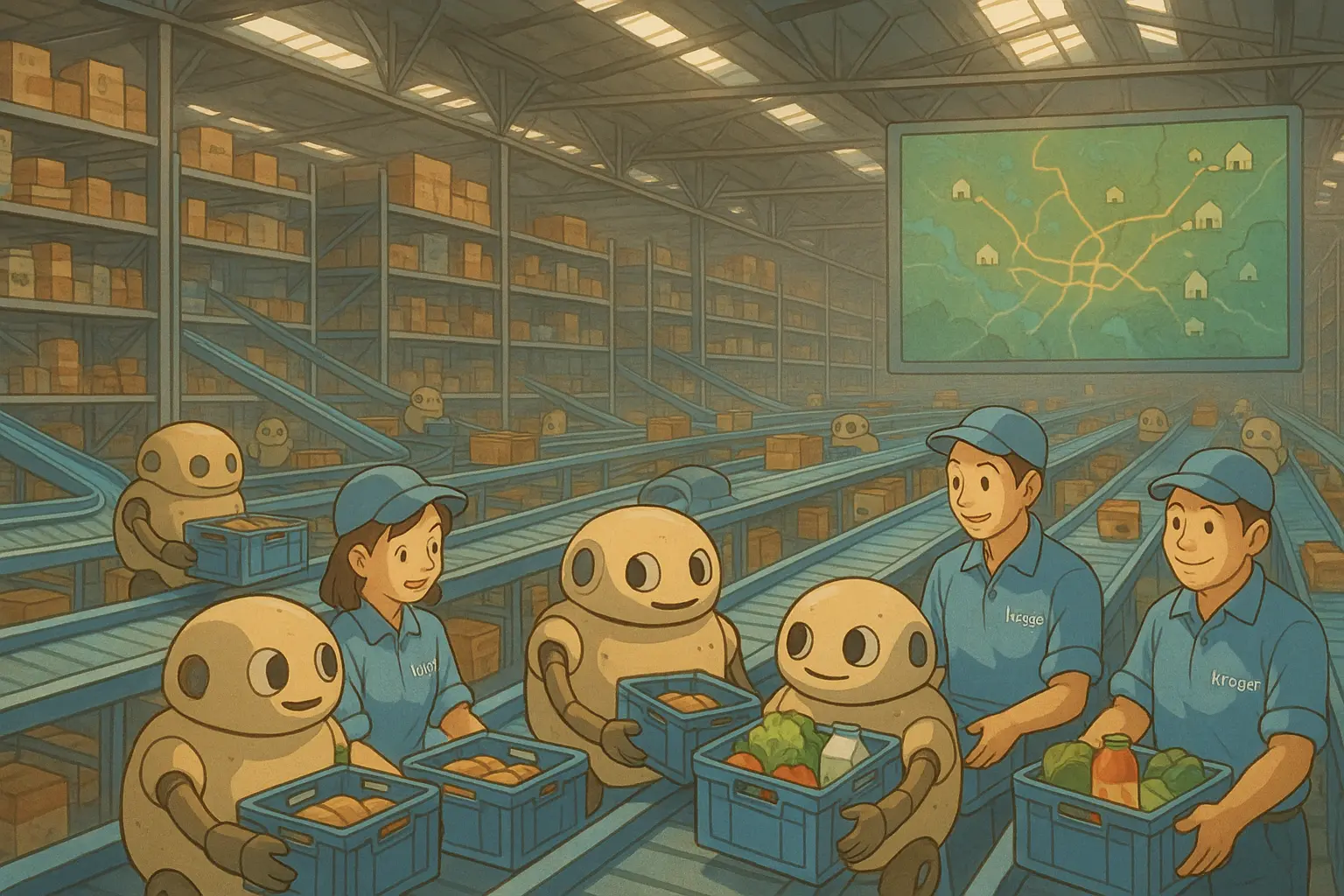
Kroger’s customer fulfillment centers are highly automated warehouses that were designed in partnership with Ocado.
They were supposed to be the engine of Kroger’s e-commerce operations. But after an underwhelming performance, the company is now considering the rollout and is shifting its fulfillment strategy entirely to stores in 2025.
In this article, we discuss why Kroger’s fulfillment strategy changed and the lessons it holds for other supply chains.
Key Nuggets:
- Kroger halted its expansion of Ocado-powered automated warehouses in 2025, as costs outweighed benefits in many markets.
- The company transitioned to store-based fulfillment, utilizing existing retail space and AI to enhance speed and reduce costs.
- This pivot increased e-commerce speed, helped Kroger beat earnings forecasts, and slowed Ocado’s U.S. growth prospects.
- African supply chains can adopt these lessons by leveraging existing store networks, managing capital costs effectively, and remaining flexible in tech deployment.
The Background Story of Kroger’s Customer Fulfillment Centers
In 2018, Kroger partnered with the UK-based Ocado to roll out 20 highly automated “Customer Fulfillment Centers” (CFCs), each of them designed to coordinate and facilitate the fulfillment of online grocery orders.
The fulfillment centers were towering, capital-intensive warehouses. And the integration of robotics made the sorting, picking, and packing of groceries seamless. The idea was to merge the company’s scale with speed and precision.
Between 2019 and 2023, Kroger gradually rolled out eight of these stores in high-density markets, including Ohio, Florida, Georgia, Wisconsin, Michigan, Colorado, and Maryland.
However, real estate, demand misalignment, and growing last-mile expectations made the model harder to justify in some regions.
By 2023, Kroger began “pumping the brakes” on new Ocado centers and easing the rollout pace with the intention of making the existing CFCs “work as well as they could” before scaling up.
Over the same period, Kroger’s e-commerce business did grow, but profitability remained a challenge. For example, Kroger’s online sales rose steadily (up 12% in late 2022 and up 16% in Q1 2025), but the margins on grocery delivery were generally thin.
Read More: The BMW’s Wire Harness Supply Bottleneck Caused By Ukraine’s Invasion.
Kroger’s Customer Fulfillment Centers Go Local
Following the failed Albertsons merger and CEO change in 2025, the company put a pause on future CPCs.
Ron Sargent, Kroger’s interim CEO and chairman of the board, noted that where customer density is high, Ocado centers “deliver better results,” but in lower-density markets, “customer adoption was slower.”
The point is that the costs were high and the benefits weren’t universal, which forced the company to pause further investment into the CPCs and rigorously review each existing site individually.
Moreover, customers were starting to expect same-day, even two-hour, delivery. That level of speed was hard to deliver from a giant hub.
Kroger’s stores were already well-established and stocked, though. And behind the scenes, the company was scaling fulfillment from its retail stores.
Over 2,700 locations were activated to support online grocery orders. Relying on AI batching tools, store staff were able to pick, pack, and ship orders directly from shelves.
Kroger realized in real-time that, instead of leveraging complex robotics, the company could turn its stores into micro-fulfillment centers. And the strategy was paying off. For example, delivery timelines shrank compared to the CPCs.
By Q2 2025, 97% of stores could support two-hour delivery windows via Kroger’s delivery partner Instacart.
The shift also meant that capital was being spent on updating physical locations, rather than just building new automated centers.
Kroger announced plans for 30 new store projects in 2025, which is a 30% increase over its original pipeline.
Read More: How Samsung’s Poor Quality Control Led to the Galaxy Note7 Crisis.
The Impact of Pausing Kroger’s Customer Fulfilment Centers
Financially, the switch paid off
Online sales rose 16% in Q1 2025, delivery orders surpassed pickup for the first time, and overall earnings exceeded forecasts.
Operationally, it gave Kroger flexibility. Using AI in-store for order picking reduced the burden on staff and improved speed without requiring major new investments.
Strategically, it shifted momentum away from automation vendors.
For Ocado, it was the worst kind of news. The company’s share price dropped 10% following the announcement, and analysts warned that it could negatively impact the company’s U.S. ambitions.
Do you want more supply chain stories like this? Subscribe here
Lessons From The Failure of Kroger’s Customer Fulfillment Centers
Retailers have long believed automation was the future. However, Kroger demonstrated that automation without a solid strategy was ineffective.
Here are some of the key lessons from the story:
1. High-Tech Isn’t Always the Smartest Investment
Technology is great, but the smartest move for your supply chain isn’t building what looks modern; it’s building what works across the board.
Every dollar Kroger invested in building the automated warehouses could have been spent improving stores, cutting prices, or making deliveries faster. Automation, when done wrong, eats capital. Kroger realized that and pivoted.
2. Don’t Fight Customer Behavior. Adapt to It
Last-mile delivery in retail now depends more on geography than on technology, which is why proximity is a non-negotiable factor.
Ocado’s model worked best for scheduled grocery orders, which made sense in the early 2020s. But by 2025, customers weren’t waiting days. They wanted groceries in minutes.
Kroger’s logistics adapted fast. Instead of waiting for technology to catch up, the company utilized its existing infrastructure, upgraded it with software, and met customer expectations.
Read More: How Chip Shortage Crippled Sony’s PS5 Supply Chain.
How African Supply Chains Can Apply These Lessons
With all the talk about technology and the need for African supply chains to embrace it, Kroger proved that smart decisions beat shiny technology. Here is what more supply chains across the continent should do:
1. Use the Network You Already Have
Micro-fulfillment doesn’t require robotics, but it does need coordination and smart routing, so leverage existing networks such as existing outlets, open-air markets, and informal distribution points. That way, you can deliver fast and avoid massive overhead costs.
Ultimately, what matters is how efficient and effective the fulfillment process is.
2. Prioritize Flexibility Over Complexity
Kroger’s fulfillment strategy shifted from automated warehouse models to store fulfillment because flexibility paid more than the shiny technology.
African supply chains, which are often faced with fluctuating demand, inadequate infrastructure, and limited budgets, should prioritize making smart decisions and maintaining flexibility in their operations. At the end of the day, smart decisions beat shiny technology.
3. Invest in Simple Tech That Multiplies Speed
African retailers don’t need robotics to compete. Kroger scaled performance by deploying tools that help people work faster, rather than replacing them. Simple tools, well-deployed, can shrink lead times and foster trust.

Obinabo Tochukwu Tabansi is a supply chain digital writer (Content writer & Ghostwriter) helping professionals and business owners across Africa learn from real-world supply chain wins and setbacks and apply proven strategies to their own operations. He also crafts social content for logistics and supply chain companies, turning their solutions and insights into engaging posts that drive visibility and trust.