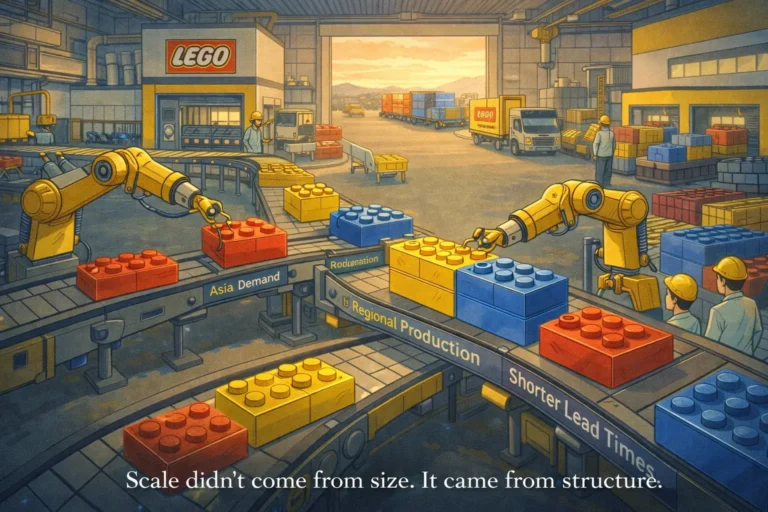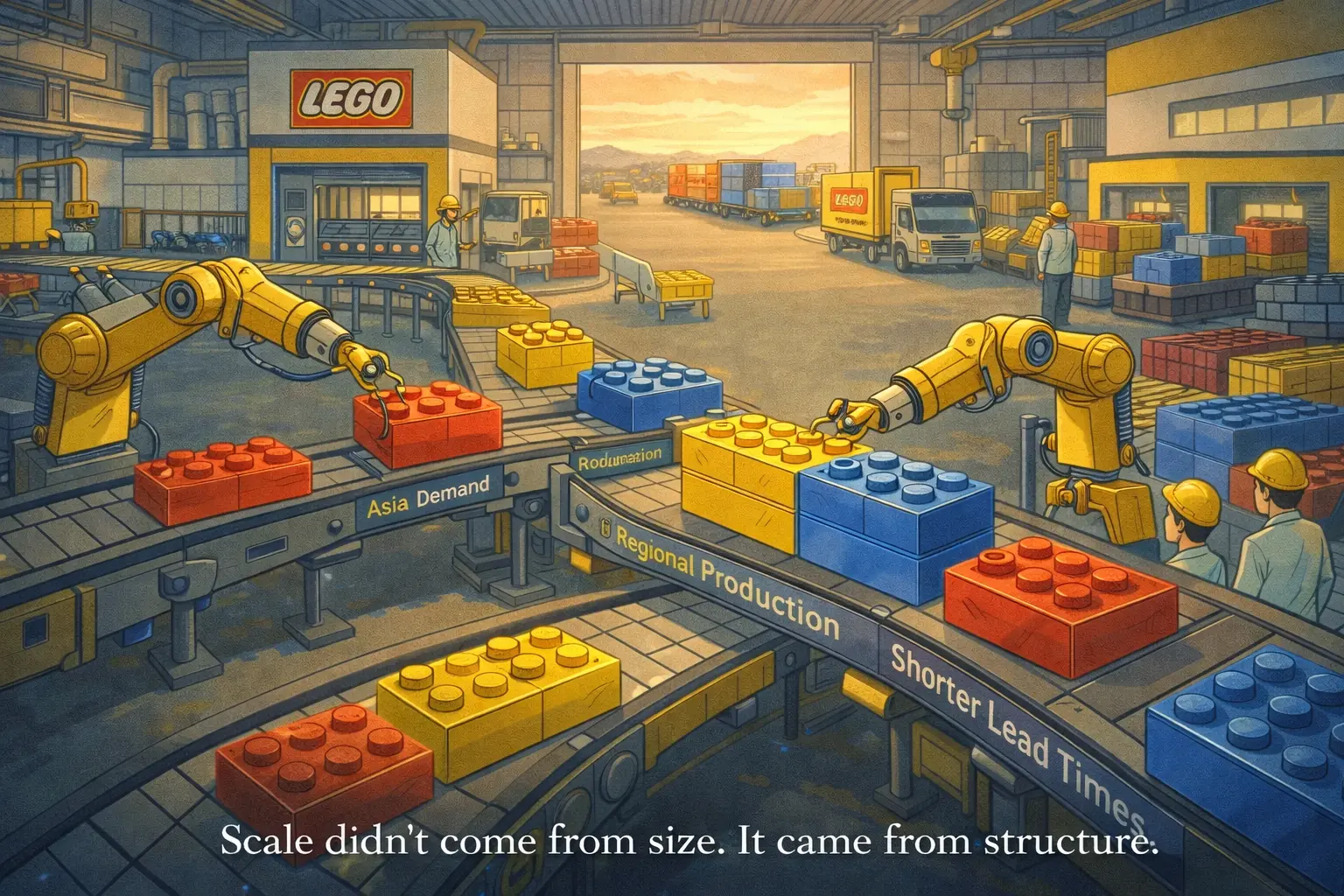
LEGO’s expansion of its supply network in Asia is an effective demonstration of how regional manufacturing, when carefully sequenced and aligned with demand realities, delivers speed, shock absorption, and control.
This article explores how LEGO’s supply network was expanded across Asia to manage demand growth, reduce distance to market, and shield itself from disruption.
It also explores what smaller supply chains, especially in Africa, can take from the strategy, even with fewer resources.
Key Nuggets:
- Demand for LEGO products in Asia outpaced the company’s sole plant in China.
- To manage it, LEGO had to open a second site in Vietnam and expand its factory in China to share the load.
- The Vietnam site came with a new distribution hub to support faster replenishment across Asia.
- Shorter transport lanes reduced freight cost exposure and improved seasonal stock alignment.
- African supply chains can apply similar moves by creating options near their largest demand zones.
Why LEGO Rebuilt Its Supply Network in Asia
LEGO’s supply network in Asia was overly concentrated in a single location. But by 2021, the company was experiencing growth problems.
Since 2019, Asia-Pacific demand has grown by double digits each year. In 2024, LEGO reported 13% global revenue growth and a 46% increase in the product portfolio— the largest in company history.
That kind of growth creates pressure. And holiday demand made it worse. LEGO’s sales were also spiking towards the end of the year, with more than 40% occurring before December. One late shipment was enough to ruin a quarter.
It was also increasingly clear that a single plant was no longer sufficient.
Before expansion began in 2021, 90% of Asia-Pacific demand was sourced from the company’s factory in Jiaxing, China. It worked when demand was steady, and lanes were open. However, when conditions deteriorated during the global shipping crisis, everything changed.
From 2020 to 2021, shipping rates shot up from $3,200 to over $22,000 per container. And as if that wasn’t enough, fewer than half of the ships arrived at the ports on time.
Within the same period, the number of LEGO stores increased from 140 in 2019 to more than 300 by 2021, and India’s toy market was projected to double by 2028.
Read More: Inventory Lessons From The Red Sea Crisis Disruption of Volvo’s Supply Chain.
At this point, LEGO’s leadership was shrewd enough to recognize that regional demand was surging and the global system no longer provided the buffer it once did. China alone couldn’t carry it. And something had to be done immediately.
The company faced a choice: either expand where demand resides or continue to miss the market window.
The Impact of LEGO’s Expansion Of Its Supply Network
In 2021, LEGO announced a $1 billion investment in a new factory in Vietnam. At the same time, the company began expanding its Jiaxing plant in China. The idea behind the two-site model was to separate production and risk and to avoid service gaps during the buildout.
In April 2025, the new Vietnam plant opened, becoming the company’s sixth global factory and its second in Asia. Meanwhile, Jiaxing received 42,000 square meters of new buildings, including an automated warehouse, a molding line, and additional processing space.
LEGO’s expansion of its supply network reduced distance and increased speed. The company could now meet Asia-Pacific demand from either Vietnam or China, which was good for growth and risk. If one route fails, the other can hold the line.
Read More: How Nestlé Nigeria Is Leveraging Local Sourcing to Combat the FX Crisis.
Vietnam helped with the cost. Near-market production meant fewer long-haul moves, thereby reducing exposure to container price shocks. During the shipping crunch, many supply chains had no fallback. LEGO had just built one.
Vietnam also became a testbed. Its factory operated on solar power, employed large-scale battery storage, and phased out plastic in prepackaged bags. These changes helped prevent future compliance problems and enhanced the resilience of the energy supply.
Do you want more supply chain stories like this? Subscribe here
The Distribution Layer: Where the Real Speed Lives
A fast factory needs a fast outbound flow. That’s why LEGO supported the Vietnam site with a regional distribution hub in Dong Nai province. Operated by Kuehne+Nagel, it was scheduled to begin operations in late 2025, serving Southeast Asia, Oceania, and parts of South Asia.
The distribution center was built to handle 150 containers per week. It gave LEGO a two-hub setup in Asia, with Shanghai covering the north and Dong Nai covering the south.
Read More: How One Supplier Brought Stellantis Operations to a Halt.
This setup enabled the LEGO Asia distribution network to move products more quickly and directly into local channels. It also reduced stock in transit and improved replenishment for markets such as Malaysia, Singapore, Japan, India, and Indonesia.
Lessons From LEGO’s Supply Network Expansion
LEGO’s regional manufacturing strategy holds lessons for manufacturing supply chains in rapidly growing economies. Some of them include:
1. Demand Growth Must guide your network:
LEGO expanded in the same region where sales were rising fastest. Unfortunately, many supply chains often lag behind their growth zones. That delay incurs costs that they underestimate.
2. Staged Growth Protects The Customer.
LEGO grew in Jiaxing before launching in Vietnam. In fact, the launch in Vietnam was a response to the company’s supply strain. By staging growth, the company had the capacity to meet demand without delay during the startup phase.
Do you want more supply chain stories like this? Subscribe here
3. Seasonality Requires Speed, Not Just Planning.
LEGO’s past stockouts taught them the cost of delay. Local production fixed the response time, and speed beat forecast accuracy.
4. Distribution is The Secret Engine.
Factories make products. But distribution moves it to the shelf. Vietnam’s new hub ensured stock arrived on time across multiple markets.

Obinabo Tochukwu Tabansi is a supply chain digital writer (Content writer & Ghostwriter) helping professionals and business owners across Africa learn from real-world supply chain wins and setbacks and apply proven strategies to their own operations. He also crafts social content for logistics and supply chain companies, turning their solutions and insights into engaging posts that drive visibility and trust.