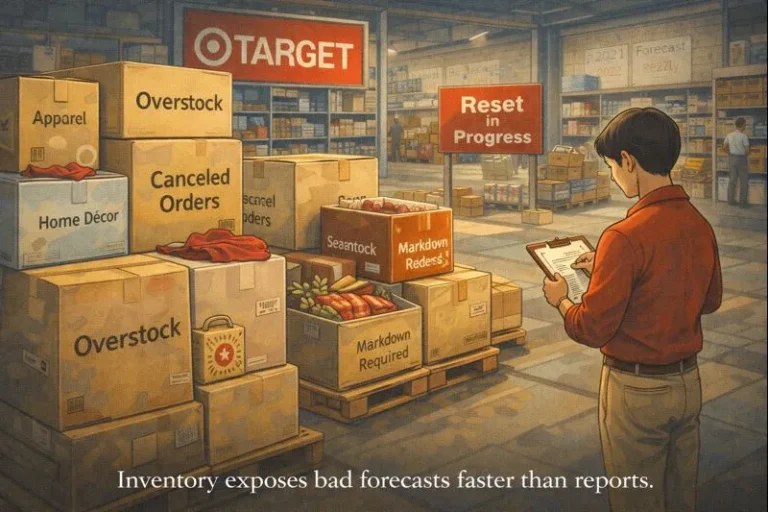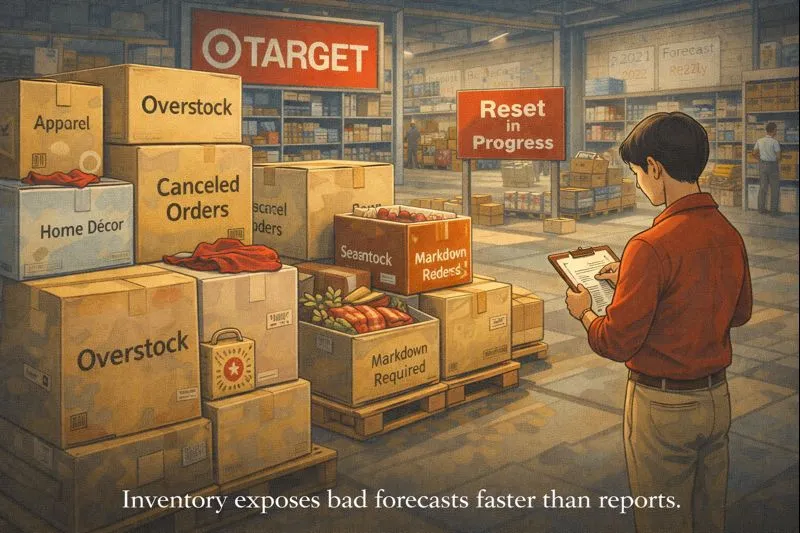
Target’s 2022 excess inventory crisis stemmed from a misreading of demand velocity. The company had stocked up, confident that the pandemic-driven habits would continue. But consumers flipped the script.
Now, this isn’t just a story about markdowns or canceled orders. It’s about how a well-meaning strategy can turn costly when demand shifts faster than supply chains can react. For any business that holds inventory, especially in volatile markets, this is a case worth studying.
Key Nuggets:
- Target overstocked in 2021–22 by betting on past consumer behavior instead of analyzing future trends.
- The shift in demand from goods to services hit fast, leaving warehouses full of unsold discretionary items.
- Target took short-term pain, such as the $5 billion in lost operating income, to reset faster than competitors.
- Their fix included order cancellations, markdowns, smarter segmentation, and leaner inventory.
- African supply chains can build flexibility, respond faster, and stop treating all products the same.
In this article, we examine how Target fell behind on its inventory, how it caught up, and what supply chain operators, especially in Africa, can learn from it.
The Reason Behind Target’s Inventory Crisis in 2022
Target had grown quickly between 2020 and 2021 by stocking up when competitors couldn’t. That strategy made sense when global supply chains were clogged, and demand was predictable. But the assumptions changed. Target didn’t.
The retail giant entered 2022 with record sales and an aggressive ordering model. It also doubled down on discretionary inventory, including home goods, electronics, and furniture, based on patterns from the lockdown years.
But in reality, shoppers were shifting toward services, essentials, and food. That left Target with $1.1 billion in unsold goods by early 2022.
Read More: How Pepkor’s Supply Chain Navigated the 2023 Port Disruptions in South Africa.
What Triggered Target’s Inventory Crisis?
At the root of Target’s inventory glut was a collision of several forces at once. None of these forces was extreme in isolation, but together they became the perfect squeeze.
1. Demand Switched Faster Than Forecasts Could Follow
Post-pandemic, consumers began living in their homes again. Travel, restaurants, and entertainment were back on the shopping budget. Meanwhile, big TVs and air fryers no longer topped the list.
Unfortunately, this went beyond just a minor tweak to preferences. It was a complete reversal of demand. And according to Target’s CEO, the company did not anticipate the magnitude of the shift.
2. Inflation Punched Discretionary Spending
By June 2022, U.S. inflation had reached 9.1%. Food prices jumped 11.4% year over year, and fuel prices were surging as well. Most shoppers had less money for non-essential purchases and were shifting spending from general merchandise to essentials such as groceries.
But general merchandise was one category where Target had overinvested.
3. Long Lead Times Created a Delivery Lag
To beat stockouts during the pandemic, Target ordered big, and they ordered early. Lead times stretched 12–20 weeks. But by late 2021, shipping normalized. Products arrived faster, just as shoppers stopped wanting them.
4. High Inflation Skewed Order Economics
When inflation is high, bulk buying makes sense. Holding more inventory is cheaper than paying higher prices later. That logic prompted Target to increase order quantities despite weakening demand.
Read More: How Twiga Changed Food Distribution in Kenya.
The Tipping Point: Two Warnings in Three Weeks
On May 18, 2022, Target shocked analysts. Inventory was up, earnings missed by 29%, and profits were down 43% from the previous year.
Three weeks later, Target made a second announcement. Operating margin would collapse to 2%. CEO Brian Cornell called it an “aggressive campaign” to address inventory misalignment.
The fix wasn’t subtle.
- $1.5 billion in fall orders were canceled.
- Markdowns swept across product categories.
- Pricing was adjusted to handle freight cost spikes.
- Liquidators were engaged to clear the overstock.
- Temporary warehouse space was secured near ports.
- Supply plans were rewritten to focus on food, essentials, and beauty
What Did All That Cost?
Target’s Q2 2022 operating profit dropped 87%. Over the full year, profit fell by $5.1 billion and gross margins shrank by 3%. Warehouse space, supplier penalties, markdowns, and sales disruption added to the pain.
The loss wasn’t just financial, though. Relationships with vendors were strained. Store teams faced cluttered floors and lower morale. Executives had to trade growth initiatives for crisis control.
Still, Cornell stood by the move: “We’re confident this rapid response will pay off for our business and our shareholders over time”.
How Target Recovered From The Inventory Crisis
By mid-2023, that prediction proved accurate. Inventory dropped 17% year over year, discretionary stock fell 25%, operating profit rebounded 273%, and in-stock performance was the best in four years.
Target achieved this by doing three things right.
Do you want more supply chain stories like this? Subscribe here
1. Segmented Inventory Strategies by Category
Target stopped treating all items the same. Essentials were stable, but discretionary items weren’t. So they:
- Built up inventory for food, household, and personal care
- Pulled back on home goods, electronics, and apparel
- Created flexibility in buying so teams could “chase” trends, not commit early
This change in how inventory is planned and executed enabled Target respond to demand rather than react late.
2. Invested in Infrastructure, Even During the Crisis
Instead of freezing, Target expanded. The company added new sortation centers, enhanced upstream storage, and maintained its distribution pipeline. But the goal was speed rather than size.
Holding products closer to ports meant they could be deployed only when needed, rather than pushing them through the entire network on assumptions.
3. They Got Smarter With Forecasting
Machine learning and AI were deployed to detect category-level shifts earlier. This helped Target keep inventory lean while still meeting shopper needs.
Christina Hennington, Chief Growth Officer, said this approach allowed them to “react quickly to changing trends” without clogging stores or storage.
Read More: Lessons From LEGO’s Supply Network Expansion in Asia.
Lessons From Target’s Inventory Crisis
Target’s course correction required faster decision-making, stronger visibility, and the humility to cut losses early. Here’s what African retail supply chains can take away.
1. Don’t Treat All Inventory the Same
Segment what you sell.
- Essentials (e.g., baby food, cooking oil, household staples): forecast more confidently
- Discretionary (e.g. electronics, fashion, large equipment): plan with room to pivot
This will protect your warehouse space and capital during downturns.
2. Invest in Flexibility, Not Just Capacity
It is easy to fall into the trap of thinking you need more space when what you really need is better space. Holding inventory upstream—in a vendor’s warehouse or near a port—buys you time. That time lets you decide based on real demand, not forecasts made months ago.
This is especially useful in Africa, where import delays or market shifts can make firm commitments risky.
3. Speed Beats Precision
If demand shifts, act rather than waiting for “more data.” Target showed that fast, imperfect action recovers faster than slow, calculated analysis.
For example:
- If sales of a category stall for 3 weeks, freeze future orders.
- If costs spike, revisit purchase plans weekly rather than monthly.
- If warehouses fill up, don’t push more through—clear first, then restock.
4. Cut So You Can Grow Again
Target accepted a year of lost profit to reset quickly. That reset made room for growth.
Avoiding the pain might feel better in the moment, but it delays recovery.

Obinabo Tochukwu Tabansi is a supply chain digital writer (Content writer & Ghostwriter) helping professionals and business owners across Africa learn from real-world supply chain wins and setbacks and apply proven strategies to their own operations. He also crafts social content for logistics and supply chain companies, turning their solutions and insights into engaging posts that drive visibility and trust.